Hybridizing adaptive intelligent tutoring systems with generative AI.
GAIMHE is an industry-academic project coordinated by EvidenceB, carried out with Inria, and funded by BPI France. It explores how generative AI can be integrated into adaptive intelligent tutoring systems without giving up pedagogical control, frugality, or real-world deployability.
Why GAIMHE?
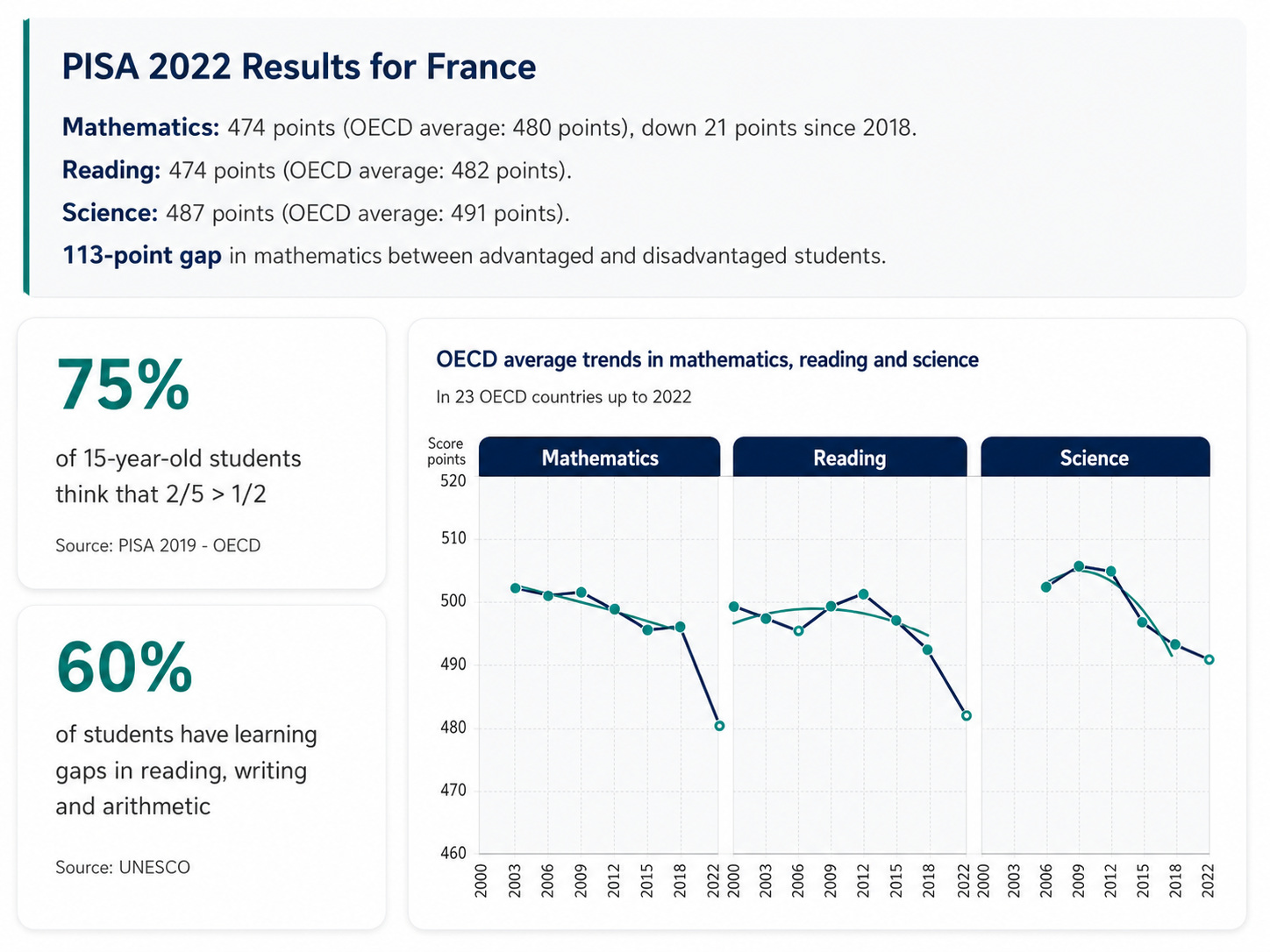
Education systems face major challenges. PISA 2022 reports a sharp decline in mathematics and reading performance across OECD countries, while socio-economic background continues to strongly shape student achievement. Digital technologies can help, but only when they are used purposefully, regulated responsibly, and made available equitably; otherwise they can reinforce the inequalities they are meant to reduce.
Adaptive learning addresses part of this challenge by personalizing learning paths to each learner's level and progression. EdTech companies have therefore developed Intelligent Tutoring Systems with strong pedagogical grounding, but these systems have not yet fully benefited from recent advances in generative AI.
The Hybrid Opportunity
Current educational AI systems face a structural tradeoff.
Adaptive intelligent tutoring systems can personalize learning trajectories over weeks or months, rely on explicit pedagogical structures, and have already been deployed at classroom scale. Their main limitation is the cost of producing high-quality exercises, hints, feedback, metadata, and pedagogical graphs by hand.
Generative AI can produce content and interact in natural language, but unconstrained use raises risks: factual errors, weak pedagogical alignment, over-helpful feedback, high inference cost, and limited control for teachers and instructional designers.
GAIMHE investigates a hybrid path: keep the adaptive tutoring system in charge of pedagogical sequencing, and use generative models under explicit constraints where they add value.
Controlled generation inside adaptive systems
The project keeps long-term pedagogical decisions inside the tutoring system and uses generative models only where they can be constrained, validated, and monitored.
Adaptive core
Learning paths remain structured by expert-authored pedagogical graphs and adaptive sequencing algorithms such as ZPDES.
Offline generation
LLMs are used to pre-generate exercises, distractors, hints, and feedback from explicit specifications and expert examples.
Targeted assistance
Real-time generation is reserved for pedagogically justified situations, such as repeated errors or explicit help requests.
Validated commons
Datasets, documentation, tools, and evaluation protocols are progressively shared as research resources and digital commons.
Current Resources
Public material is added progressively as it becomes ready for scientific dissemination.
Research Questions
GAIMHE contributes to research in AI for education by studying how to combine the structured efficiency of classical student modeling with the representational flexibility of modern generative and multimodal models. The project focuses on practical questions that matter for deployment: what should be generated, when generation should happen, how generated resources should be validated, and how models can be evaluated against real learning histories rather than only isolated exercises.
Partners
GAIMHE is carried by research, educational technology, open-source AI, infrastructure, and dissemination partners.