Architecture at a Glance
The architecture links offline generation, validated datasets and benchmarks, personalized exercise support, and adaptive curriculum sequencing.
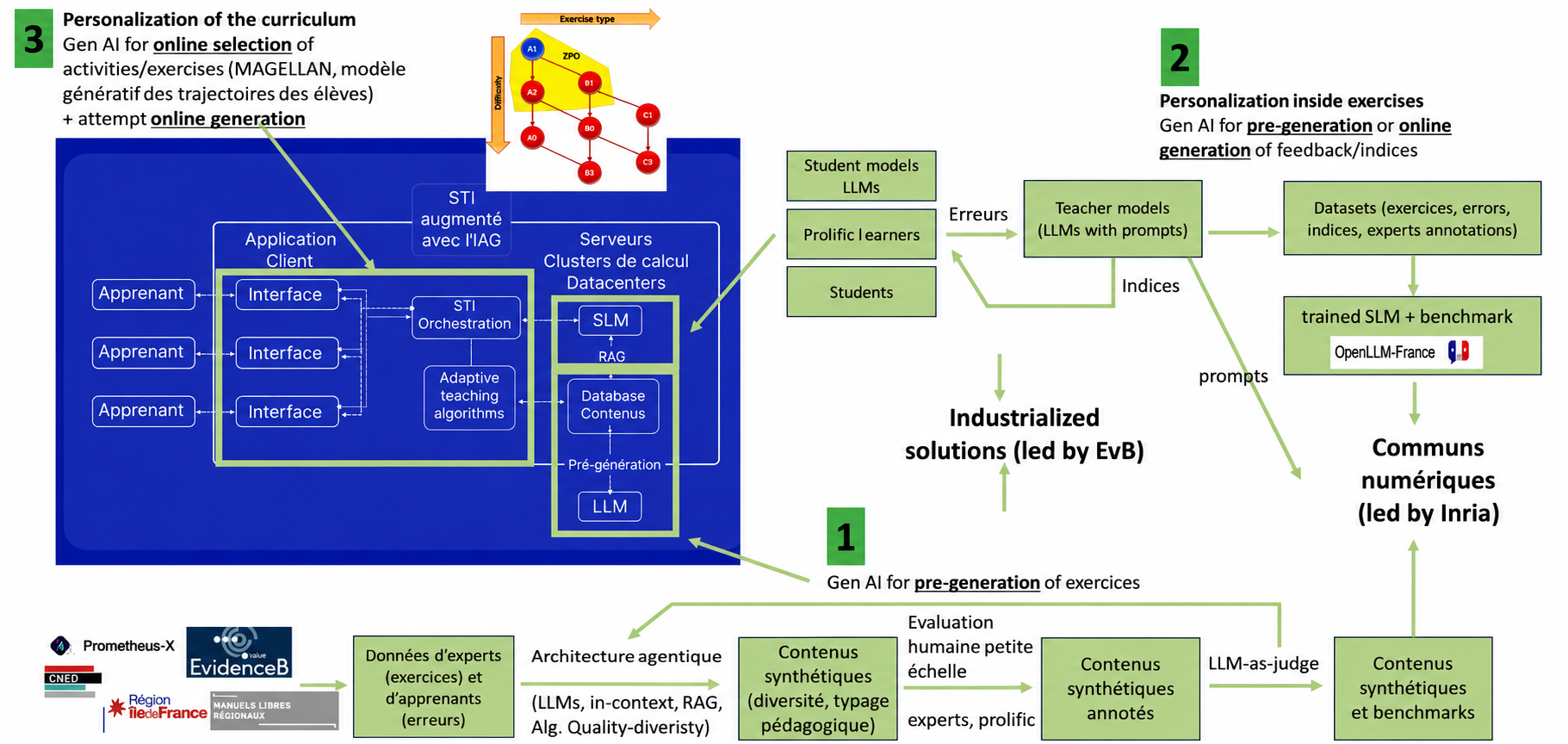
Adaptive Tutoring Core
The project builds on adaptive learning platforms such as Adaptiv'Math and MIA Seconde. In these systems, educational content is organized as pedagogical graphs: modules contain objectives, objectives contain activities, and activities contain exercise variants. The graph encodes prerequisite relations and constrains which activities can be proposed to a learner.
The adaptive engine remains responsible for sequencing. Algorithms such as ZPDES select activities according to observed learning progress, rather than asking a generative model to decide the curriculum directly. This separation keeps personalization grounded in an explicit pedagogical structure.
Generative Modules
At the macro-pedagogical level, generative models are used offline. They can produce exercise variants, distractors, hints, and feedback from expert-provided templates and specifications. Each generated resource must remain aligned with a target objective, activity type, school level, interaction format, and expected misconception or difficulty.
At the micro-pedagogical level, real-time generation is treated as targeted assistance. It may be triggered when a learner asks for help, repeats incorrect answers, spends unusually long on a task, or produces an open response that is difficult to classify. The generated response should support progressive scaffolding without revealing the answer too early.
Validation Pipeline
GAIMHE treats validation as a core part of the architecture. Generated resources are evaluated against explicit codebooks covering correctness, clarity, level appropriateness, pedagogical alignment, plausibility of distractors, and the quality of hints or feedback.
The project explores LLM-as-Judge methods as pre-filtering tools, not as replacements for pedagogical expertise. Human annotations by teachers and experts provide the reference signal used to calibrate automatic checks, clarify codebooks, and identify cases where model-based judging is unreliable.
Offline first
Generation is moved offline whenever possible, so validated resources can be reused at scale.
Filtered before review
Automatic checks help experts focus on ambiguous or pedagogically important cases.
Limited real-time use
Online generation is reserved for clearly justified pedagogical situations.
Auditable resources
Shared documentation and datasets make generation and evaluation pipelines easier to inspect.
Frugal by design.
The architecture is designed for classroom-scale use. Generating every exercise or feedback message with a large model in real time would be costly, slow, and difficult to deploy responsibly.
GAIMHE therefore separates resource production from classroom execution and limits real-time generation to cases with clear pedagogical value.
Evaluation Perspective
The project evaluates hybrid AI for education through several complementary questions: whether generated content is pedagogically valid, whether adaptive sequencing remains effective with generated resources, whether models can exploit rich educational histories, and whether the resulting systems remain frugal enough for large-scale deployment.